


I spent my first three years of serious betting almost exclusively on the Premier League. The data was everywhere, the coverage was relentless, and the markets felt familiar. Then a friend dragged me into a Championship accumulator one Tuesday night, and within a month I’d shifted half my bankroll to the second tier. Not because Championship betting is easier — it absolutely is not — but because the inefficiencies are so much more visible once you know where to look.
The EFL Championship is, by most statistical measures, the most competitive domestic league in Europe. Twenty-four clubs, 46 matches each, three promotion places, three relegation slots, and a play-off system that turns the final weeks into pure chaos. Sky Bet has sponsored the EFL for thirteen consecutive seasons now, and that relationship has only deepened the connection between England’s lower divisions and the betting public. For anyone willing to do the homework, this division rewards analytical effort in ways the top flight simply cannot match.
What follows is an honest breakdown of how I approach Championship betting — the structure, the markets, the patterns, and the traps that catch even experienced punters.
How the Championship Works as a Betting Proposition
A mate once described the Championship as “the Premier League’s waiting room, except half the people in it are heading in the wrong direction.” That’s not far off. The division operates on a 24-team format with no winter break, meaning fixture congestion is a genuine tactical variable you can exploit.
Two clubs earn automatic promotion to the Premier League via the top two finishing positions. The teams placed third through sixth enter the play-offs — a knockout format culminating in a Wembley final often called the most valuable single match in world football. At the other end, the bottom three drop to League One.

This structure creates distinct betting phases across a season. August through October is the settling period, where newly relegated Premier League sides and promoted League One clubs are still finding their level. November through February is the grind, where squad depth separates pretenders from contenders. March through May is where promotion and relegation markets move fastest, and where I’ve found the sharpest edges over the past decade. Understanding these phases matters more than any individual statistic, because Championship odds reflect narrative momentum far more than underlying performance data.
Promotion Odds and the Outright Market
Every summer, the promotion outright market opens with a familiar pattern: the relegated Premier League clubs are installed as short-priced favourites, newly promoted sides are priced as cannon fodder, and everyone in between occupies a messy band of 8/1 to 25/1. The reality rarely matches these opening prices.
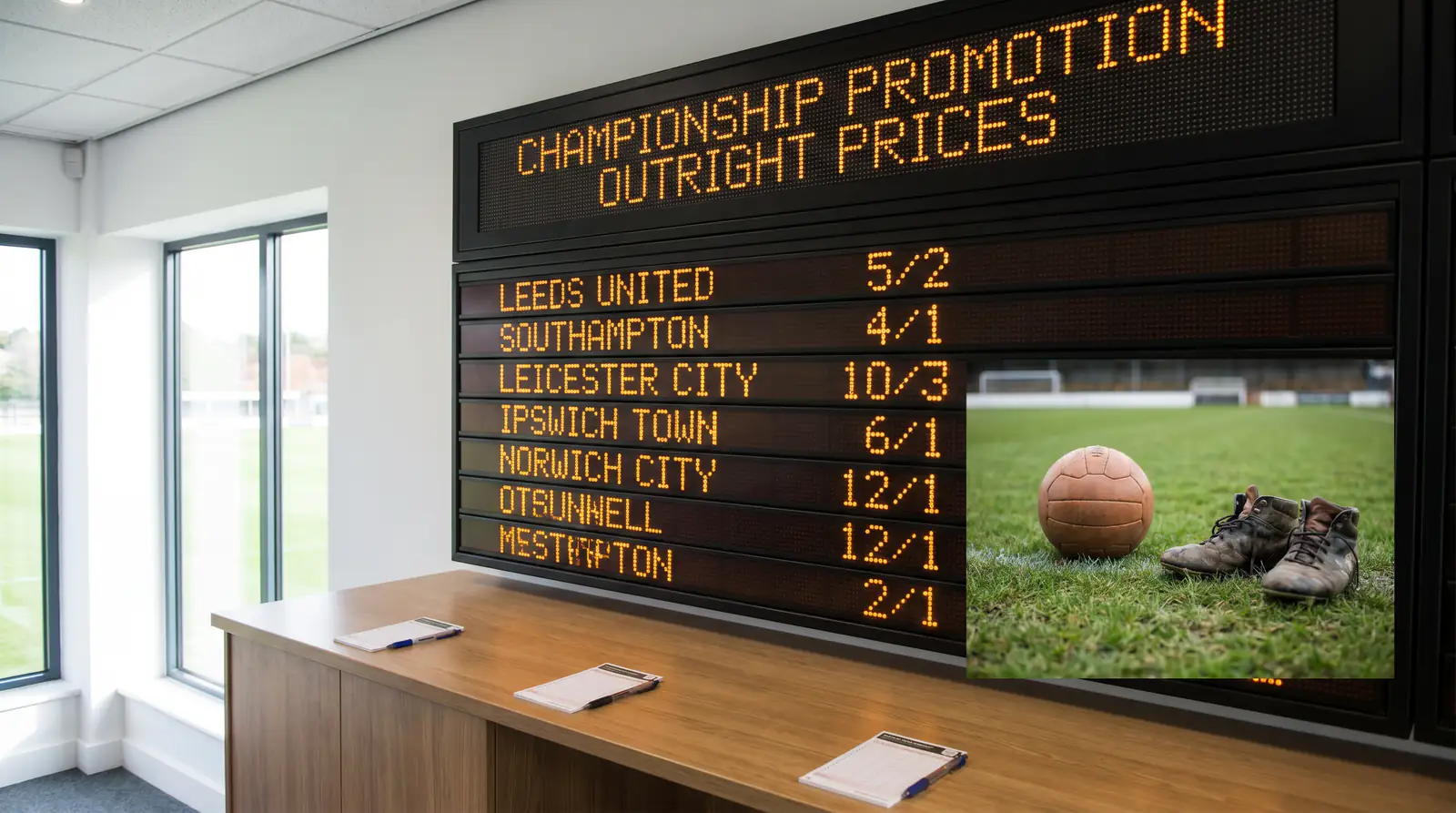
I’ve tracked Championship promotion markets for seven seasons, and the pre-season favourite has earned automatic promotion roughly 40% of the time. That’s better than chance, but nowhere near the implied probability their opening odds suggest. The value tends to sit with clubs in the 10/1 to 16/1 range — teams with a settled manager, a core of experienced Championship players, and a summer of targeted recruitment rather than a scattergun overhaul. If you’re serious about EFL promotion betting, early-season timing is everything, because these prices compress dramatically once the table starts taking shape around November.
Relegation outright markets follow a similar logic in reverse. Promoted sides are automatically priced as favourites for the drop, but clubs with financial instability or managerial chaos mid-season often drift to far more generous prices before the market catches up to their decline.
Play-Off Betting: Where Chaos Meets Opportunity
I once watched a play-off semi-final where the away side trailed 3-0 on aggregate at half-time and won on penalties. If that sounds like an outlier, it isn’t — not in this division. The Championship play-offs are statistically the most unpredictable post-season format in English football, and that unpredictability creates genuine betting value.

The play-off market typically opens once the regular season picture clarifies, around mid-April. What I’ve learned is that the team finishing third is not always the strongest play-off contender. Momentum matters enormously. A side that’s won six of their last eight to scrape into sixth often carries more psychological energy into the semi-finals than a third-placed team that’s been coasting. Draws are more common in lower-league football than in the Premier League, and that pattern holds in the play-offs too. The draw no bet market can be a sensible way to back the underdog in these fixtures without exposing yourself to the full downside.
Betano’s representative captured the commercial dimension neatly when discussing their commitment to English football: they see their entry into the Premier League as a long-term investment, not a short-term sponsorship play. That kind of operator confidence trickles down to Championship coverage too — more markets, better liquidity, and tighter spreads than we saw even five years ago.
Match Betting Patterns Worth Tracking
Here’s what ten years of Championship data has drilled into me: home advantage is stronger in the second tier than in the Premier League, but it’s also more volatile. A team can be dominant at home for two months, then lose three straight at their own ground after an injury to a key defender. The Premier League has enough squad depth to absorb these shocks; the Championship does not.

The most reliable pattern I’ve found relates to Tuesday and Wednesday night fixtures. Midweek Championship matches — and there are plenty of them across a 46-game season — tend to produce fewer goals than Saturday fixtures. The reasons are straightforward: shorter recovery windows, rotated squads, and more conservative tactical setups. The under 2.5 goals market on midweek Championship away fixtures has been one of my steadiest performers over the past five seasons.
Another pattern worth noting: newly promoted sides from League One tend to start brightly but fade around December when the physical and tactical demands of the Championship accumulate. I’ve had consistent success fading these clubs in the match result market during the winter period, particularly when they’re priced as marginal favourites at home against mid-table opposition.
The 290 million online bets placed on real events every month in the UK include a significant Championship share, and as data coverage of the division improves, the edges are getting thinner. But they haven’t disappeared — they’ve just shifted from obvious spots to places where you need to dig a layer deeper into squad data, managerial records, and fixture context.
Why the Championship Rewards Specialists
The single biggest advantage of Championship betting over Premier League betting is information asymmetry. Major bookmakers employ full-time traders for the top flight. Their Championship coverage, while improving, still relies more heavily on algorithms and less on granular squad knowledge. If you’re willing to watch the matches, follow the local press, and track metrics like expected goals at a team level rather than just results, you’re operating with information the market hasn’t fully priced in.

That doesn’t mean every Championship bet is a value bet. The margins are still against you, and the bookmaker’s overround on second-tier match odds is typically higher than on Premier League fixtures. But the frequency of mispriced outcomes is higher too, and that’s where the edge lives.
Articles
Created by the "leaguebettips.com" editorial team.
