

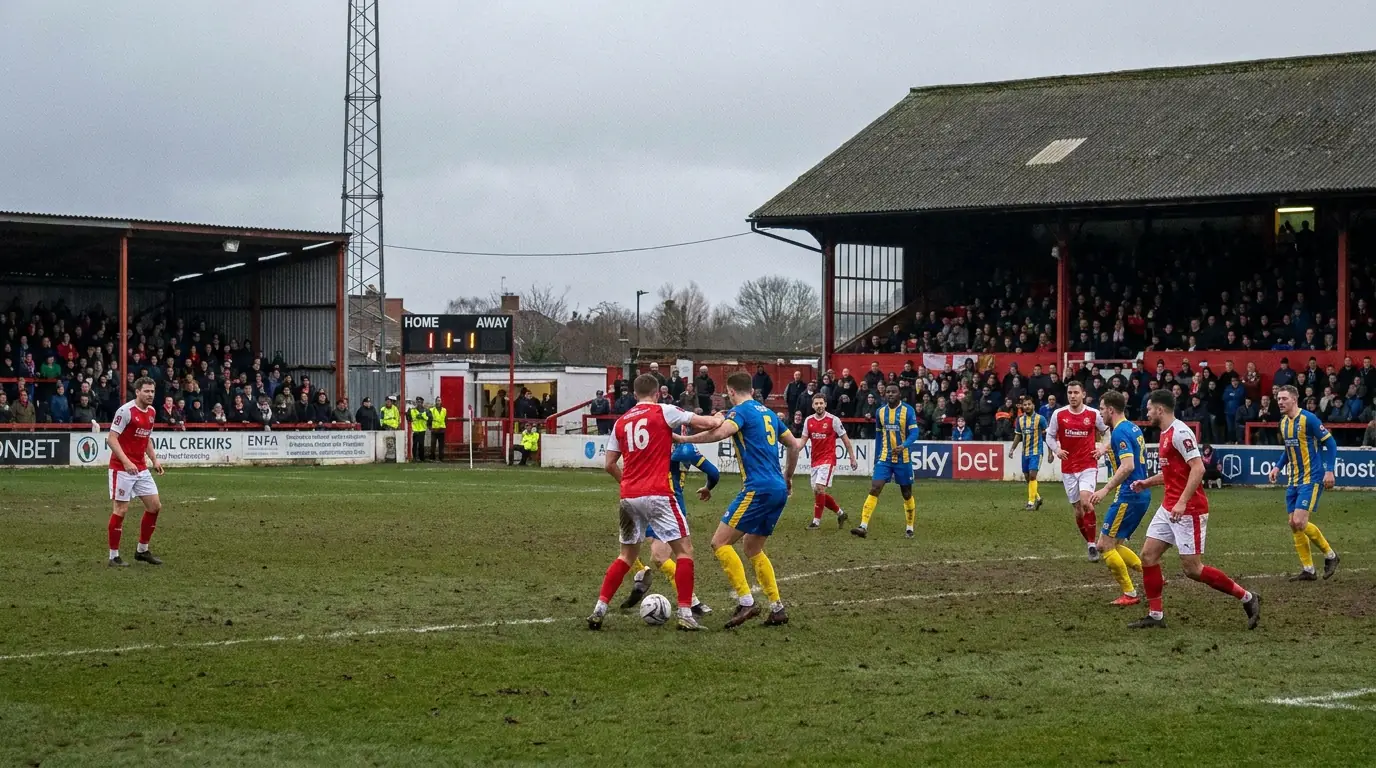
The most satisfying bet I placed last season wasn’t on a Premier League blockbuster or a Championship promotion clash. It was a 3.80 away win in the National League on a Tuesday night, in front of 2,400 people, on a pitch that had seen better decades. I knew the away side’s manager had changed formation after two losses and that the home team’s centre-back was suspended. The market knew neither of those things, because nobody was paying attention. That’s the entire proposition of National League betting in a single paragraph.
The National League sits at the fifth tier of English football — immediately below League Two and above the regional National League North and National League South. It’s the highest level of non-league football, featuring a mix of full-time professional clubs, semi-professional outfits, and a few teams that have bounced between the EFL and the fifth tier multiple times in the past decade. The UK has 8,148 licensed gambling premises including 5,669 betting shops, and the National League is covered by most major operators — but with a fraction of the depth and liquidity that higher divisions command.
What Markets Are Actually Available
If you’re expecting the same market depth as a Premier League fixture, adjust your expectations now. A typical National League match offers between 8 and 15 markets pre-match: match result, over/under goals (usually 2.5 only), BTTS, correct score, double chance, and sometimes draw no bet. First goalscorer and Asian handicap markets appear occasionally for televised matches or high-profile fixtures but are not standard.

The match result market is where almost all the liquidity sits. Prices are typically wider than equivalent EFL fixtures — a home favourite might be priced at 1.65 in the National League where a comparable fixture in League Two would be 1.55 — reflecting both the higher uncertainty and the lower trading volume. That wider pricing is simultaneously the disadvantage (higher overround) and the advantage (more room for mispricing) of operating at this level.
In-play markets for the National League are sparse. Only matches selected for live streaming by bookmakers attract meaningful live betting options, and even then the market range is limited to match result and sometimes next goal. If your approach relies on live betting, the National League is not the division for you. Pre-match analysis is the only viable path to consistent engagement with these markets.
Liquidity Constraints and Stake Limits
Here’s the practical reality that separates National League betting from the EFL: stake limits are low, and they’re enforced aggressively. I’ve had match result bets of 20 pounds refused by operators who happily accept 500 pounds on a Championship fixture. The economics make sense from the bookmaker’s perspective — their exposure management on a fifth-tier match is fundamentally different from a televised Premier League game — but for bettors trying to extract value from an informational edge, the limits are a genuine constraint.

Spreading bets across multiple operators helps, but even with four or five accounts, the total exposure you can build on a single National League fixture rarely exceeds 100-150 pounds. That ceiling means National League betting works best as a supplementary activity within a broader portfolio rather than a standalone strategy. Ten percent of the UK population bets on sport online, and the vast majority of that volume flows into the Premier League and Championship, leaving the National League as a niche within a niche — quiet enough to find edges, but too constrained to build a bankroll on alone.
Why Specialisation Creates a Genuine Edge
The informational gap between you and the bookmaker is wider in the National League than at any other level of English professional football. Major operators use algorithmic pricing models calibrated on historical data, but the National League’s high turnover rate — of players, managers and even entire squad compositions between seasons — means historical data is less predictive here than at any EFL level.

A bettor who follows eight to ten National League clubs closely — reading the local press, watching highlights, tracking suspensions and injuries through club social media — holds information that the bookmaker’s algorithm genuinely lacks. I’ve seen National League match result prices that implied a 40% home win probability when the home side’s starting striker was suspended and their replacement had scored once in fourteen appearances. That kind of mispricing doesn’t survive in the Premier League for thirty seconds. In the National League, it sits there until kick-off because nobody with money on the line is looking.

The draw rate in the National League is comparable to League Two — around 26-28% of matches — and the goal-per-match average sits between 2.3 and 2.6 depending on the season. These patterns are stable enough to form the basis of systematic approaches to goal line and BTTS markets, though the lower liquidity means you’ll need patience and multiple accounts to deploy those approaches at meaningful volume.
The Promotion and Relegation Angle
The National League promotes one team automatically and one via the play-offs to League Two, and relegates clubs to the National League North and South. These outright markets are available from most operators, with promotion prices opening around 6/1 to 20/1 depending on pre-season assessments. The play-off structure adds the same kind of variance that makes EFL play-off betting both exciting and dangerous.
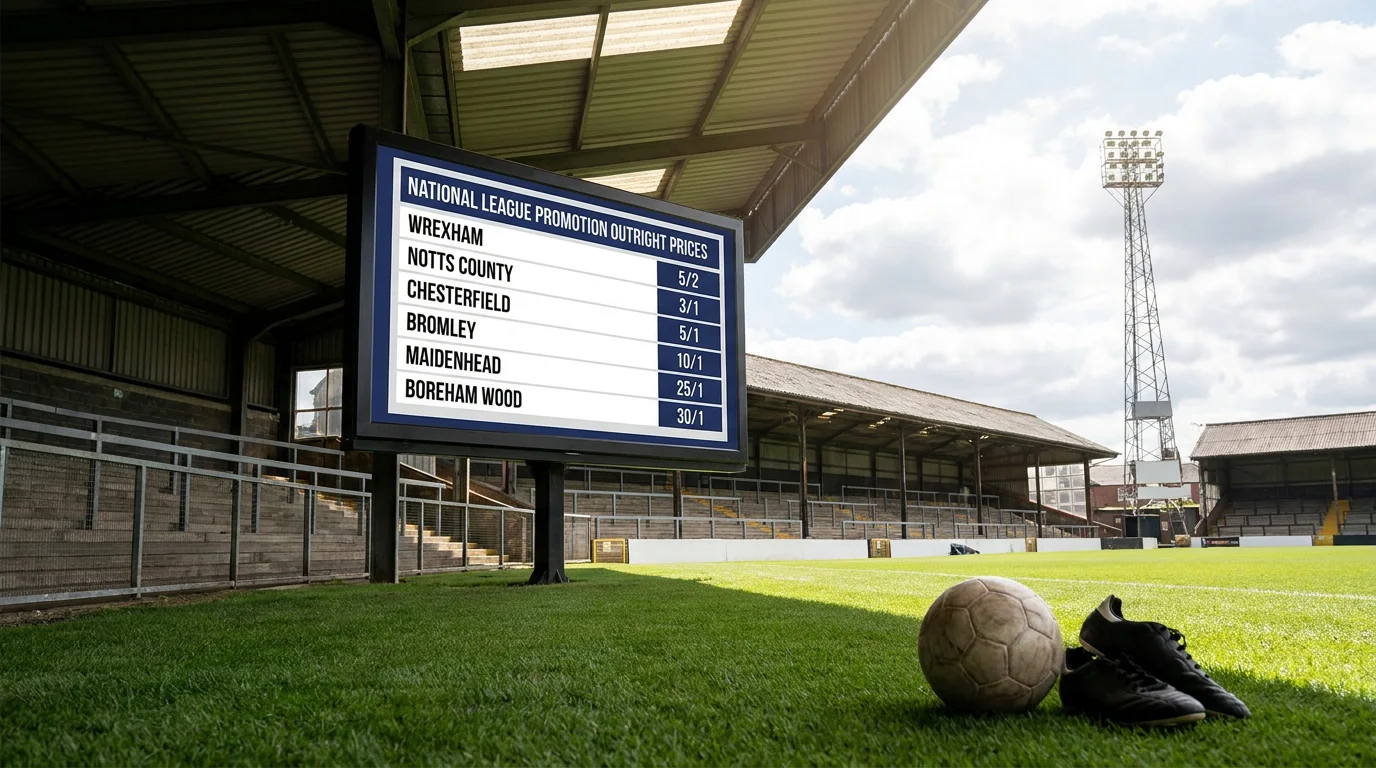
I’ve found the best value in National League promotion markets comes from identifying clubs with new ownership investment that hasn’t yet been reflected in squad quality. A club that changes hands in the summer, invests in three or four experienced EFL players, and brings in a manager with a promotion track record will often be available at 14/1 or longer in August — a price that compresses sharply if the early results match the investment.
For those interested in how the step up from National League to League Two changes the betting landscape, League Two betting covers the market differences and strategic adjustments needed when a club moves into the EFL.
Articles
Created by the "leaguebettips.com" editorial team.
