


I once backed a midfielder at 14/1 to score first in a Premier League match. He hit the post in the third minute, the ball bounced out, and a striker tapped in the rebound. My selection was sound — the player was on set pieces, had been arriving late in the box all season, and the price reflected none of that. The result was wrong, but the thinking was right, and that’s the kind of distinction that determines whether goalscorer betting is a random punt or a genuine analytical exercise.
Live football is the most popular form of sports betting in the UK, attracting 6% of all adults. Within that, goalscorer markets — first goalscorer, anytime goalscorer, and last goalscorer — are among the most actively traded markets on any given matchday. They combine the appeal of individual player analysis with the unpredictability of who physically puts the ball in the net first, creating a market that rewards research more than most bettors assume.
Goalscorer Market Types
First goalscorer (FGS) is the marquee market: you’re backing a named player to score the opening goal of the match. If your player doesn’t score first, the bet loses — even if they score a hat-trick afterwards. Prices typically range from 5.00 for prolific strikers to 25.00+ for defenders and goalkeepers.
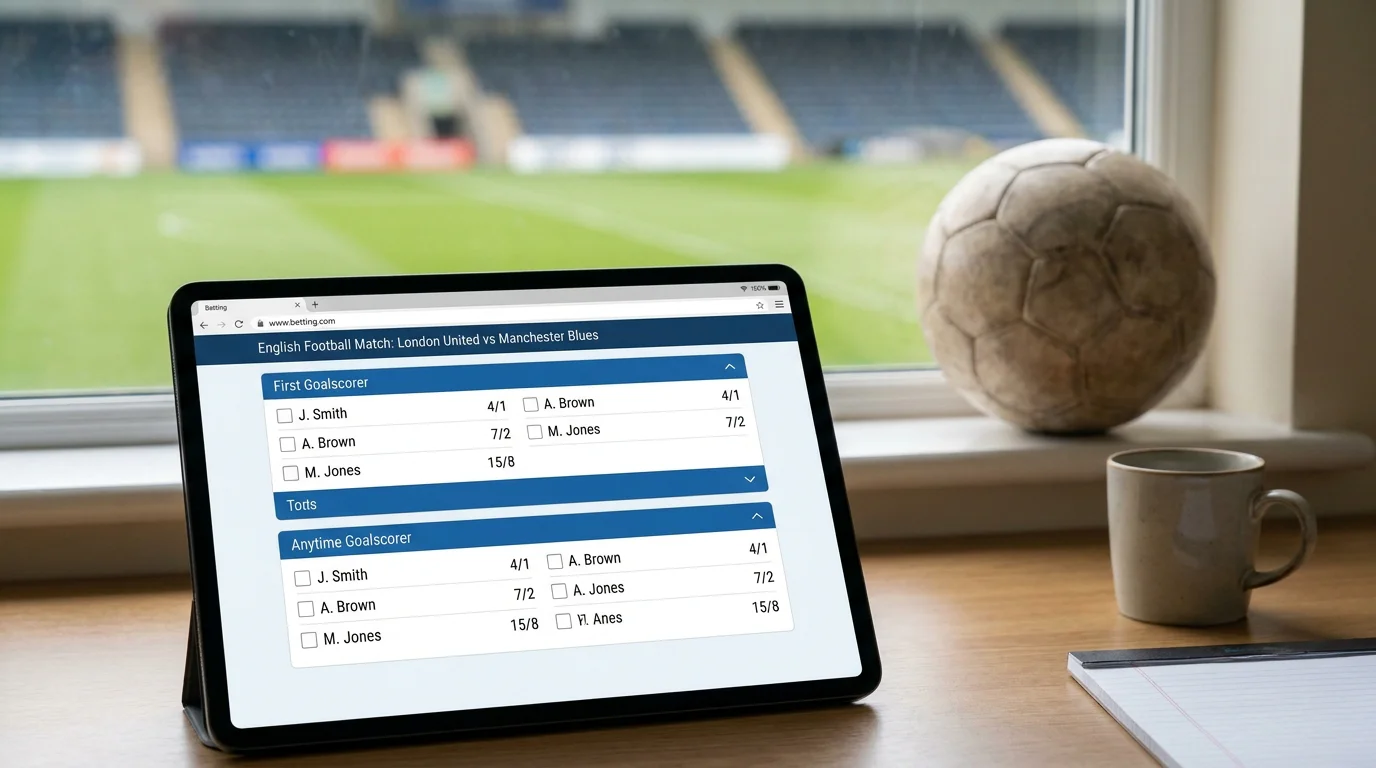
Anytime goalscorer (AGS) is the more forgiving version: your player needs to score at any point during the match, regardless of whether it’s the first, second, or fifth goal. Prices are lower than FGS because the probability is higher, but the market still carries substantial overround. Last goalscorer mirrors FGS but for the final goal of the match — it’s less popular and less liquid, but the analytical approach is similar.
Some bookmakers also offer two or more goals markets, where you back a player to score at least twice. These carry high odds and extreme variance, making them closer to correct score bets in their risk profile. I rarely use them unless a specific player’s expected goals data strongly supports a multi-goal output in a particular fixture.
Void and Settlement Rules You Must Understand
The settlement rules for goalscorer markets are more complex than for match result or over/under, and misunderstanding them is the most common source of frustration for bettors in this market. Football generates £1.1 billion in GGY in the UK, and a meaningful share of the disputes that reach Alternative Dispute Resolution services involve goalscorer market settlement.

The standard rule across most UK bookmakers: if your player is named in the starting eleven and the match kicks off, the bet stands regardless of whether the player is substituted, sent off, or injured during the match. If your player is not in the starting lineup — even if they’re on the bench and later come on as a substitute — most operators void the first goalscorer bet and return your stake. Anytime goalscorer bets typically stand for substitutes, meaning a player who comes on at half-time and scores will settle as a winner.
Own goals do not count for goalscorer bets. If the first goal of a match is an own goal, it’s disregarded for FGS purposes, and the next “proper” goal becomes the first goalscorer for settlement. If no proper goals are scored (the only goals are own goals or there are no goals at all), FGS bets are typically voided. These rules vary slightly between operators, so checking the specific terms before placing your bet is essential.
What to Look for When Selecting a Goalscorer
The obvious approach is to back the team’s main striker. The less obvious — and more profitable — approach is to think about who is most likely to score specifically the first goal, which isn’t always the player with the highest season total.

Set piece duties are enormously influential. A player who takes corners, free kicks near the box, and penalties has multiple routes to a goal that don’t depend on open-play chance creation. I weight penalty-taking duty particularly heavily in FGS analysis because penalties are scored first in approximately one in eight Premier League matches that feature them, and the conversion rate exceeds 75%.
Early-match patterns matter too. Some players are consistently involved in early attacks due to tactical setup — a striker who presses high from kick-off, a winger who’s the primary target on the opening play. These tendencies are visible in match footage and quantifiable through shot timing data. I track first-15-minute shot involvement for key players across my target matches, and the correlation between early shot volume and first goalscorer frequency is stronger than most people expect.
Anytime Versus First Goalscorer: Where the Value Sits
FGS odds are roughly 2.5 to 3 times higher than AGS odds for the same player, reflecting the additional uncertainty of timing. If a player has a 25% chance of scoring during the match (AGS probability), their chance of specifically scoring first is roughly 8-10%, depending on their team’s expected goal share and the number of goals the match is likely to produce.

I generally favour AGS over FGS for one reason: the variance is lower, and lower variance means your edge (if you have one) manifests over a smaller sample. A profitable FGS strategy might require 300+ bets to demonstrate positive returns. An AGS strategy with a similar edge can prove itself over 150-200 bets, which is a more practical timeframe for most bettors.

The exception is when I’ve identified a player whose first-goal probability is disproportionately high relative to their AGS probability — typically penalty takers on teams that win penalties frequently, or players with unusually high early-match shot volumes. In those cases, the FGS market offers better expected value than the AGS market, and I’ll take the higher-variance option.
For a broader look at individual performance markets beyond goalscoring, player props betting covers shots, tackles, cards, and other stat-based markets.
Articles
Created by the "leaguebettips.com" editorial team.
