


The first time I took corners betting seriously was during a League One season where I noticed a pattern no one seemed to be talking about. Teams managed by a particular coach consistently generated 7+ corners per home match because his tactical system relied on wide overloads and early crosses that either found a head or went behind for a corner. That single observation — connecting a tactical system to a statistical output the betting market hadn’t priced in — produced positive returns for fourteen consecutive home matches before the market adjusted.
Corners betting occupies a strange position in the UK football betting landscape. It’s offered by every major operator, traded actively during live matches, and yet receives almost no analytical coverage from the tipster community or the betting media. That vacuum of analysis is exactly what makes it interesting. The UK sports betting market generated $11.2 billion in revenue in 2024, and corners markets represent a growing segment as bettors look for alternatives to the increasingly efficiently priced match result and goals markets.
How Corner Markets Are Structured
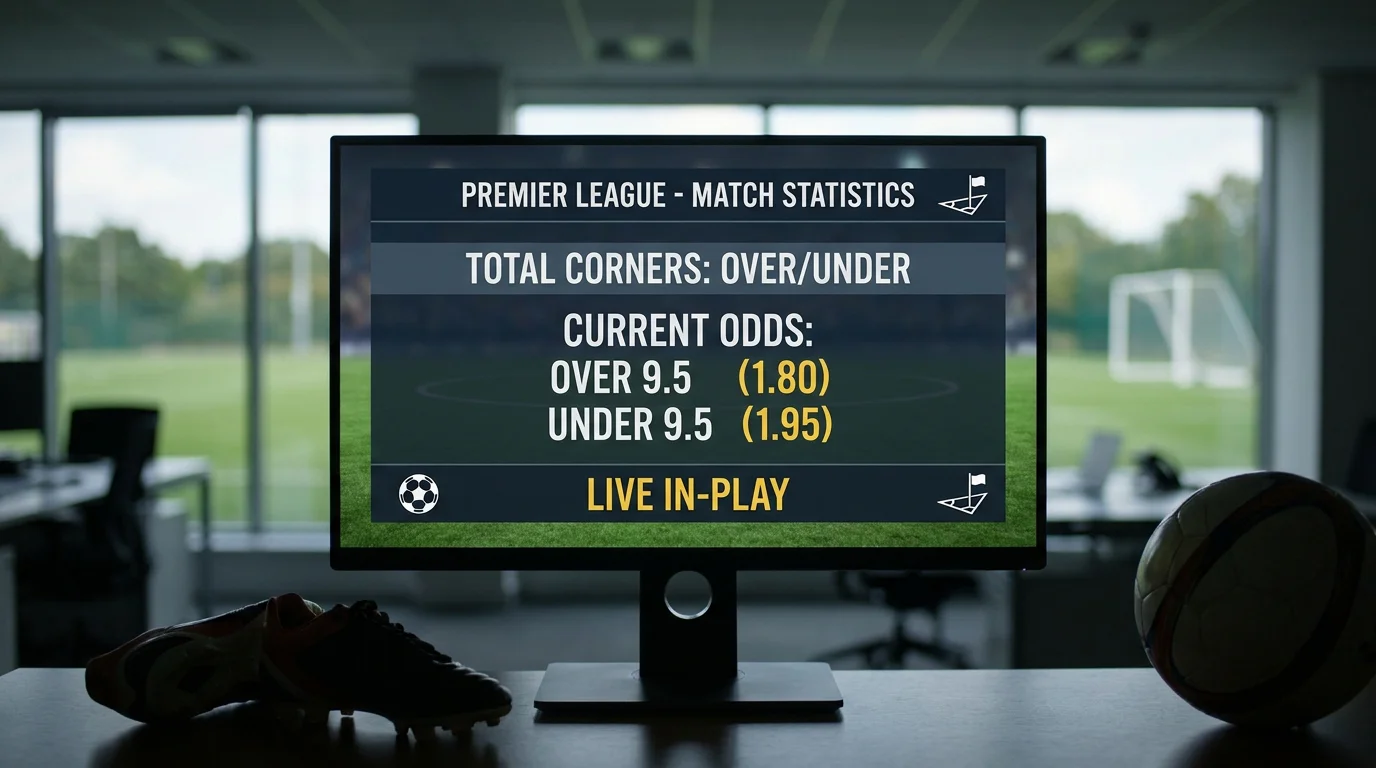
The standard corners market is a total line — over/under a specified number, typically set at 9.5, 10.5 or 11.5 for Premier League matches. The bookmaker prices both sides of the line based on the expected corner count for that specific fixture, accounting for each team’s attacking tendencies, the opposition’s defensive shape, and historical corner averages.
Team corners — over/under the number of corners won by a specific team — are available for most televised matches. These markets are thinner in liquidity, which means the pricing is less efficient. I’ve found team corners to be more analytically tractable than total corners because you’re assessing one team’s attacking profile against one defence, rather than modelling the combined output of both teams simultaneously.
Asian corner handicaps operate identically to Asian goal handicaps: a team is given a corners advantage or disadvantage, and your bet settles on whether they exceed or fall short of that handicap-adjusted total. These markets are available primarily for Premier League and Championship fixtures and carry tighter spreads than the standard over/under lines, reflecting the sharper pricing that Asian markets typically offer.
What Actually Drives Corner Counts
I spent a full season logging the origin of every corner in 200 matches across the Premier League and Championship. The results surprised me. Roughly 40% of corners came from blocked shots or crosses, 25% from defensive clearances under pressure, 20% from goalkeeper saves deflected wide, and 15% from attacking set piece situations that recycled back into corner kick territory.

The implication is clear: corner counts are driven primarily by attacking volume (shots and crosses) and defensive block rate. A team that takes 15 shots per match generates more corners than a team that takes 8, almost regardless of defensive quality. The most reliable predictor of a team’s corner output in my dataset was their shots per match combined with the opposition’s block percentage. Teams that face a lot of blocks — sides that sit deep and defend in numbers — concede more corners because those blocks redirect shots behind the goal line.
Playing style matters enormously. Teams that attack through wide areas and rely on crosses generate systematically more corners than teams that build through the centre and prioritise short passing sequences. A 4-3-3 with overlapping full-backs and wide wingers is a corner-producing system. A 4-2-3-1 with inverted wingers and central build-up is not. Forty-seven percent of UK adults participated in some form of gambling in the most recent survey period, but corners betting attracts a narrower, more analytically inclined segment of that population — which helps explain why the market remains less efficiently priced than the mainstream alternatives.

Premier League Versus Lower League Corner Patterns
Premier League matches average approximately 10.5-11 corners per game, driven by the high attacking tempo and the quality of wide play at the top level. Championship matches produce slightly fewer — around 10-10.5 — because the tactical systems are often more conservative and the quality of final-third delivery is lower.
The pattern shifts meaningfully in League One and League Two, where corner averages drop to 9-10 per match. The more direct playing styles in the lower divisions produce fewer build-up sequences that end in corners, and the lower block rate among lower-quality defences means fewer shots are deflected wide. For corners bettors, this means the standard 10.5 line that’s finely balanced in the Premier League is skewed towards the under in the lower EFL divisions — a pricing inefficiency that persists because most corners bettors focus exclusively on the top flight.
Live Corner Betting and In-Play Dynamics
Live corners markets are where the sharpest edges exist, because the bookmaker’s algorithm doesn’t process tactical shifts as quickly as an attentive match-watcher. A manager makes a half-time substitution, bringing on a winger for a defensive midfielder, and the team’s second-half attacking width increases dramatically. The goals market adjusts to this personnel change relatively quickly, but the corners line often lags by several minutes — sometimes longer for Championship and League One fixtures where the data feed is slower.

I target live corner overs in two specific scenarios. First, when a team is trailing and makes an attacking substitution before the 60th minute — the desperation to equalise produces sustained pressure, more crosses into the box, and more blocked shots, all of which generate corners. Second, when a team is dominant territorially but struggling to create clear chances — the pressure builds in the final third without resulting in goals, but it does result in corners. In both cases, the live corner line hasn’t caught up to the tactical reality of the match.
For a market that overlaps significantly with corners analysis through the lens of match tempo and attacking volume, BTTS betting offers a complementary framework for assessing which fixtures will produce the most open, attack-heavy play.
Articles
Prepared by the leaguebettips.com editorial staff.
