


When I started writing about football betting a decade ago, finding reliable market data required digging through Gambling Commission quarterly reports that nobody outside the regulatory community seemed to read. That’s changed. The UK gambling industry is now one of the most transparently reported markets in the world, and the numbers it produces tell a story that every serious bettor should understand — because the market you’re betting into shapes the odds you receive, the tools available to you, and the regulations that govern your experience.
What follows is a data-first overview of the UK gambling market as it stands in 2026, with particular focus on the sports betting segment that drives most football wagering activity. Every figure comes from regulatory filings, industry reports, or government publications.
Market Size and Gross Gambling Yield
The UK gambling industry generated 4.5 billion pounds in gross gambling yield during Q4 2025 — the period from October through December. GGY measures the total amount retained by operators after paying out winnings, making it the most accurate indicator of actual industry revenue. That quarterly figure translates to an annual run rate of approximately 18 billion pounds across all gambling sectors: remote betting, retail betting, casinos, bingo, lotteries, and gaming machines.

Remote betting — the online segment that includes all the bookmaker apps and websites most football bettors use — generates 16.8 billion pounds in annual GGY. Within that, the remote casino, betting and bingo segment produced 2.12 billion pounds in GGY for Q4 2025, with remote casino alone accounting for 1.49 billion — roughly 70% of the combined figure. Sports betting, while high-profile, is actually the smaller revenue contributor compared to casino products within the remote segment.
The UK sports betting market specifically generated $11.2 billion in revenue in 2024 and is projected to reach $21.3 billion by 2030 at a compound annual growth rate of 11.4%. Those dollar figures reflect Grand View Research’s global analysis methodology, but the trajectory is clear: the market is growing faster than most sectors of the UK economy, driven by mobile adoption, product innovation, and expanding market depth across lower-league football.
Growth Projections and Where the Money Is Heading
The overall UK gambling market is forecast to grow by $4.24 billion between 2025 and 2030 at a CAGR of 6.2%. The betting segment within that — valued at $5.61 billion in 2024 — is growing faster than the market average, pulled upward by live betting, bet builders, and the expansion of in-play markets that didn’t exist in their current form five years ago.

The online gambling market specifically generated $8.28 billion in revenue in 2025 and is projected to reach $21.9 billion by 2033 at a CAGR of 13%. That’s the fastest growth rate among all UK gambling segments, and it reflects the structural shift from retail to digital that has defined the past decade. Online now commands 78.5% of total industry revenue — a dominance that was accelerated by pandemic-era shop closures and has proven permanent.
The UK holds 11.1% of the global sports betting market by revenue, making it the second-largest regulated market in the world behind the United States. That global market share gives UK operators significant scale advantages in technology, data infrastructure, and trading capability — advantages that show up in the depth and competitiveness of odds offered to UK bettors.
Who Bets and How Often
The most recent Gambling Survey for Great Britain — Wave 4, conducted between September 2025 and January 2026 with 5,203 individual responses — found that 47% of respondents had participated in some form of gambling within the previous four weeks. Strip out lottery-only participants, and the figure drops to 26% — still roughly one in four adults.

Online sports betting specifically engages 10% of the UK population, with a pronounced gender split: 15% of men bet on sport compared to 4% of women. Football is the dominant sport, attracting 5.8% of all adults as bettors and generating 1.1 billion pounds in GGY — comfortably the largest single-sport contribution to the UK betting market. The 17.4 million UK adults who bet online in 2024 — approximately one in three — represent a customer base larger than the entire population of several European countries.
Mobile devices account for 71% of all online bets, up from 58% in 2021. Among 18-24 year olds, mobile usage rises to 76%. Ninety-five percent of online gambling takes place from home, which means the typical UK football bettor is placing bets from their sofa via a smartphone app — a behavioural profile that shapes everything from how bookmakers design their interfaces to how regulators think about harm prevention.
The Sports Betting Segment in Context
Football’s 1.1 billion pounds in GGY makes it the single largest sport for betting revenue, but it doesn’t exist in isolation. Horse racing, tennis, and cricket contribute meaningful volumes, and the growth of in-play betting — which accounts for approximately 30% of all online sports wagers — has expanded the total addressable market by creating betting opportunities that didn’t exist in pre-digital eras.
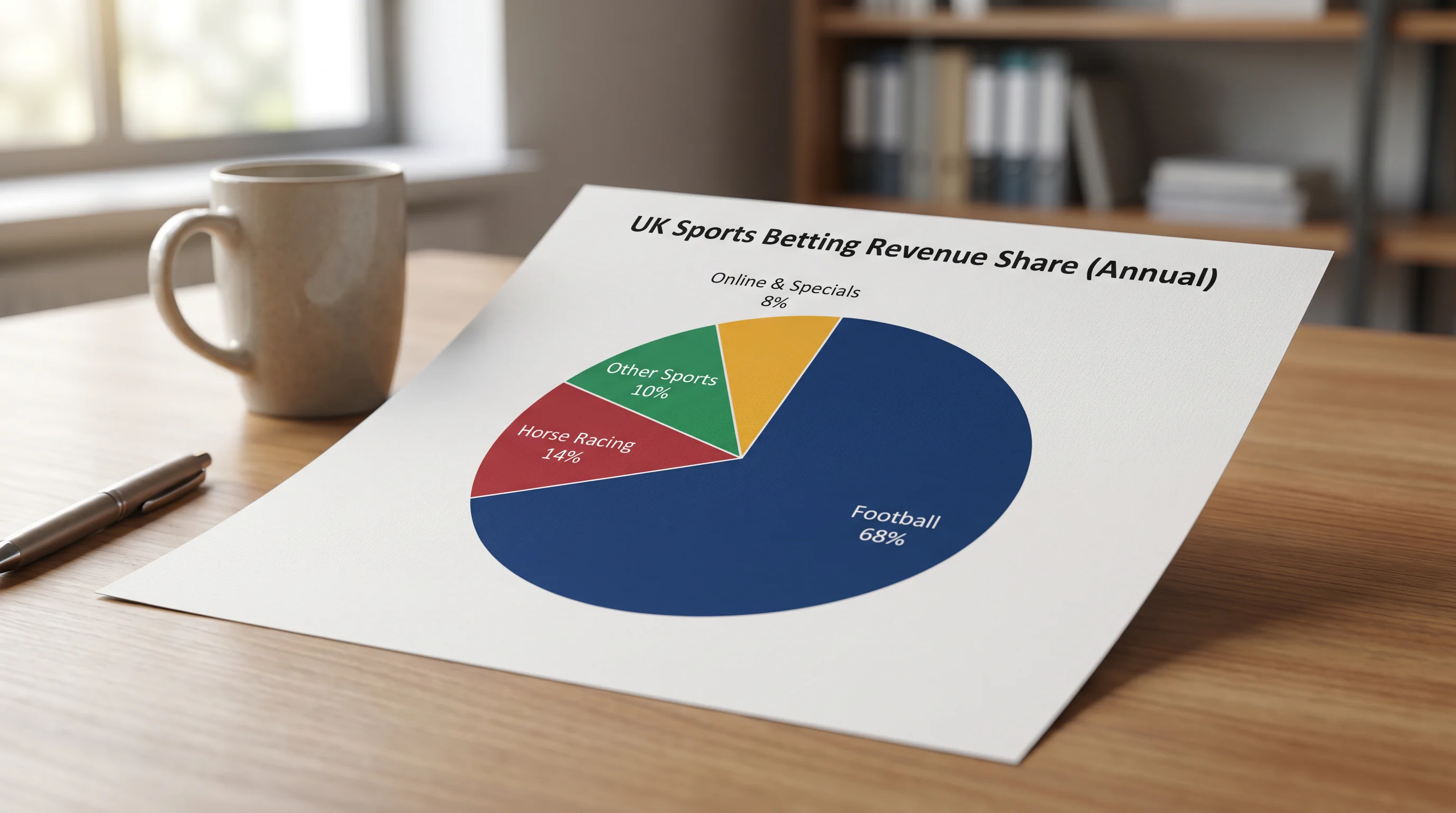
Approximately 290 million online bets on real events are placed every month in the UK. That volume creates the liquidity that keeps odds competitive and markets deep — particularly for the Premier League, where match-by-match trading volumes rival those of small financial markets. The betting industry directly supports roughly 60,000 jobs, while members of the Betting and Gaming Council collectively support 110,000 jobs and contribute 4.2 billion pounds in tax revenue plus 7.1 billion in gross value added to the UK economy.

The statutory gambling levy, introduced in April 2025, requires operators to contribute 100 million pounds annually to fund research, prevention and treatment of gambling-related harm. That levy — combined with the front-of-shirt sponsorship ban and enhanced affordability checks — represents a regulatory environment that is tightening the operating conditions for bookmakers while simultaneously expanding consumer protection for bettors.
For the specific regulatory change that’s reshaping the commercial relationship between football and betting, gambling sponsorship ban football covers the timeline, financial impact and industry response in detail.
Articles
Prepared by the leaguebettips.com editorial staff.
