


Three years ago, I made a deliberate decision to shift the majority of my betting activity away from the Premier League and into the EFL. The reason was not romantic — I did not suddenly fall in love with Tuesday nights at League One grounds. The reason was analytical: the English Football League, with its 72 clubs spread across three divisions, is where the biggest pricing inefficiencies in English football live, and where a data-driven bettor can find genuine edges that the Premier League market has long since priced out.
The EFL has been sponsored by Sky Bet for 13 consecutive seasons, with the Championship, League One, and League Two all carrying the Sky Bet name as part of the official title sponsorship. That commercial relationship places betting firmly at the centre of the EFL brand, yet the depth of analytical coverage for these divisions remains a fraction of what the Premier League receives. Fewer data providers, fewer public xG models, fewer pre-match previews, and fewer sharp bettors competing for the same edges. That imbalance is the opportunity.
This article explains how EFL betting works, how it differs structurally from the Premier League, and where value tends to emerge across Championship, League One, and League Two markets. I am writing from a position of practice — I have bet on hundreds of EFL matches over the past decade, tracked results systematically, and adjusted my approach based on what the data shows rather than what conventional wisdom assumes.
How the EFL Is Structured — and Why It Matters for Betting
Most Premier League bettors who dip into the EFL treat it as “the same thing, just lower quality.” That assumption loses money. The EFL’s structure creates dynamics that fundamentally alter how matches play out and, by extension, how you should bet on them.
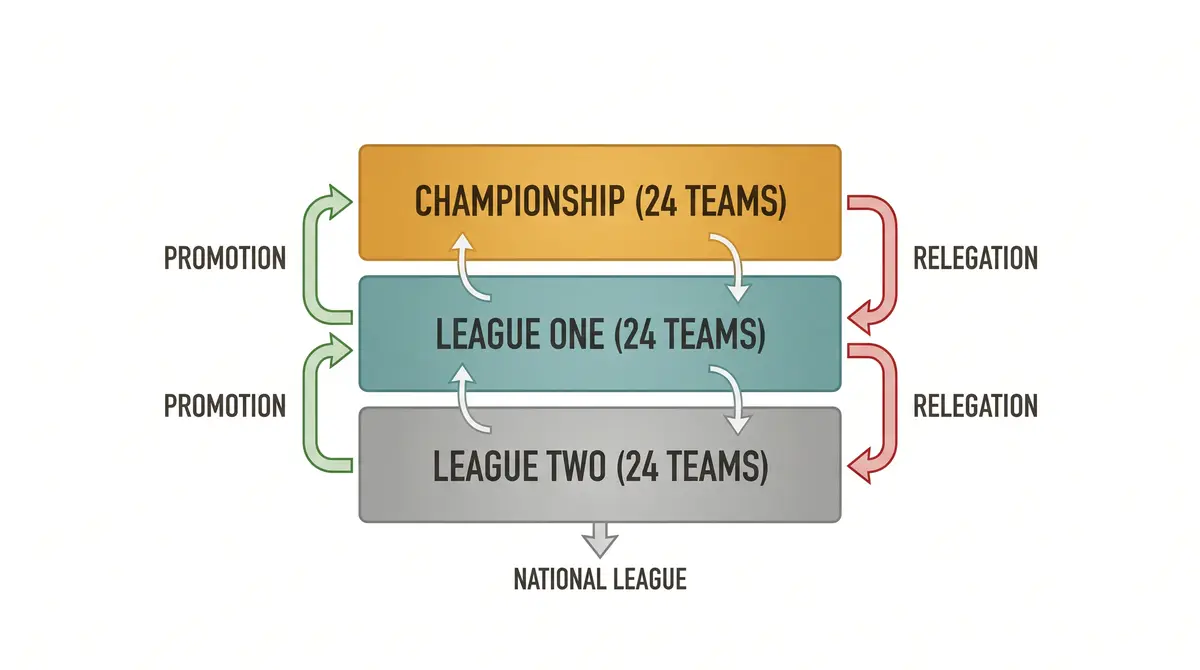
The three divisions — Championship (24 teams), League One (24 teams), and League Two (24 teams) — each play 46 league matches per season, compared to 38 in the Premier League. That 21% increase in fixture volume has direct consequences: fatigue accumulates differently, squad depth matters more, and the sample size within a single season is large enough for statistical patterns to emerge with greater reliability. A Championship side playing its 40th league match in March is a different proposition from a Premier League team at the same point in the calendar.
Promotion and relegation operate at every level: the top two in the Championship go up automatically, with the third spot decided through the play-offs (3rd through 6th place). League One and League Two follow the same structure, while the bottom two in League Two are relegated to the National League. This multi-tiered system means that the stakes at both ends of each table remain high deep into the season, creating matches with distinct motivational profiles — promotion six-pointers, relegation scraps, dead-rubber fixtures where neither side has anything to play for — each of which produces different statistical patterns.
The title sponsorship arrangement with a major betting brand gives the EFL a uniquely visible connection to the gambling industry. That visibility has not translated into deeper analytical coverage, though. The Championship receives reasonable media attention; League One and Two are afterthoughts in most national media. For a bettor, that coverage gap is an asset — less public analysis means less efficient pricing.
Championship Betting: The Most Unpredictable Division
I keep a running spreadsheet of Championship season outcomes, and the single most consistent finding across the last eight seasons is variance. The side finishing first in November finishes first at the end of the season less than a third of the time. Play-off positions shuffle constantly between December and April. Relegation battles feature at least one club that was mid-table at Christmas dropping into the bottom three by March. The Championship is not just unpredictable in the way that all football is unpredictable — it is structurally volatile, and that volatility creates opportunities.
The 24-team, 46-game format produces a relentless schedule: midweek rounds are frequent, winter fixture congestion is brutal, and squad depth separates the promotion contenders from the rest more than any other single factor. Clubs relegated from the Premier League often carry significant wage bills and parachute payments, which should make them favourites to bounce back immediately. The market prices that expectation aggressively — sometimes too aggressively. Relegated sides that fail to adapt to the Championship’s physical demands and fixture density are a recurring source of value on the lay side.
For a detailed breakdown of Championship betting markets, including promotion odds and play-off dynamics, the dedicated article goes deeper into divisional specifics. At this level, the key principle is that the Championship’s in-season volatility means outright and match-by-match markets behave differently from the Premier League. Outright markets require patience and tolerance for drawdowns; match-by-match betting requires rapid reassessment as form and squad availability fluctuate week to week.
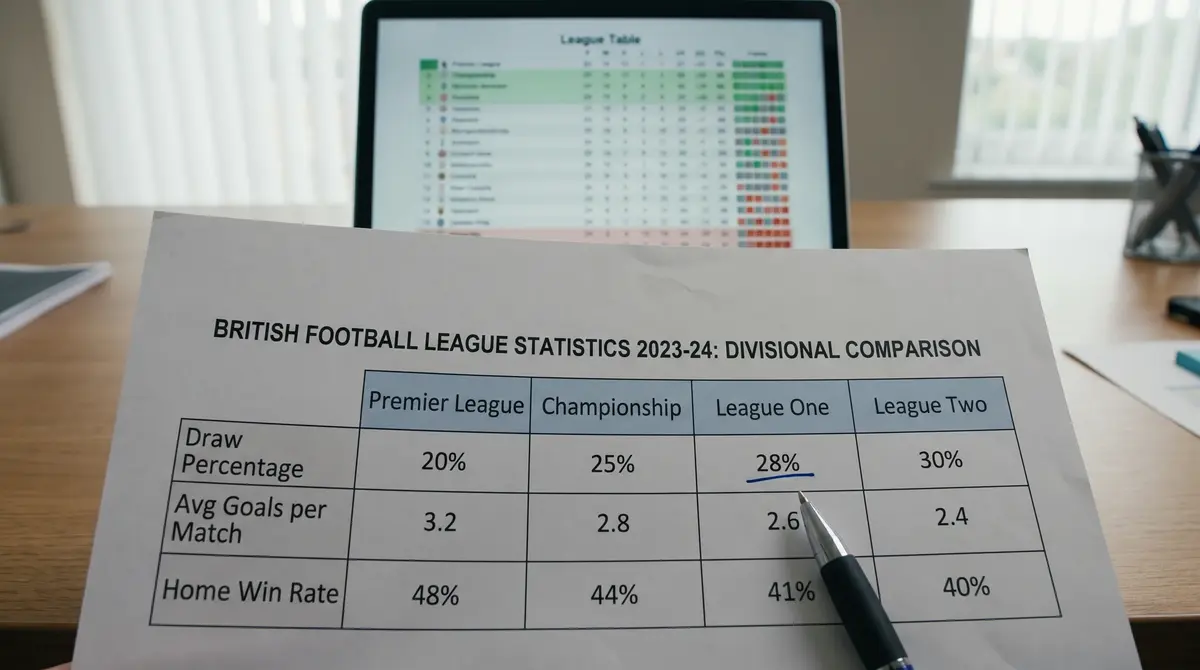
The Championship also stands apart from the Premier League in its draw frequency. The second tier typically runs 2-4 percentage points higher in drawn results than the top flight, and for a bettor specialising in draw-focused strategies — draw no bet as insurance, or backing the draw directly in specific matchups — this structural difference is worth factoring into every price assessment.
League One: Third-Tier Value and Overlooked Patterns
League One is where I first found consistent edges in English football betting, and it remains the division I bet on most frequently. The third tier combines enough fixture volume (46 matches per team per season) with enough market inefficiency to reward anyone willing to do the homework. The coverage gap is real: while the Championship gets regular television slots and national media previews, League One receives a fraction of that attention. Fewer eyes on the data means slower line movement and wider pricing gaps between operators.
Home advantage is more pronounced in League One than in either the Premier League or Championship. Travel distances are longer relative to squad budgets, away-day logistics are less professional, and the difference in pitch quality and facilities between home and away venues creates a measurable performance gap. I have tracked home-win percentages in League One over four seasons and found them consistently 3-5 percentage points above the Premier League average. That is not a trivial difference — it means the away-win price in League One should, all else being equal, be longer than the market sometimes makes it.
Market availability narrows at this level. Most operators list 30-60 markets per League One fixture, down from 150-250 for a Premier League match. The core markets — match result, over/under goals, BTTS, Asian Handicap — are available from the major operators, but player props, corners, and booking points are either absent or carry margins wide enough to make them unattractive. My approach in League One focuses almost exclusively on match result, goals lines, and the occasional draw no bet position where my analysis points to one side being unlikely to lose but not certain to win.
League Two: Betting at the Bottom of the Pyramid
League Two — the fourth tier, the bottom of the professional EFL pyramid — sits in a strange position for bettors. The analytical opportunity is arguably the greatest of any English division, because the pricing is least efficient and the data coverage is thinnest. But the practical constraints are real: fewer available markets, lower maximum stakes, wider margins on what is listed, and limited in-play options.
Scoring rates in League Two tend to sit below the Premier League average, and away-fixture goal totals are particularly suppressed. Clubs at this level often have small squads with limited attacking rotation options, which means a single injury to a first-choice striker can depress a team’s goal output for weeks. The under 2.5 goals market is one of the most reliable in League Two, particularly for away fixtures where visiting sides lack the squad depth to impose their attacking game on unfamiliar surroundings. That reliability does not mean guaranteed profit — the bookmaker knows this pattern too — but it does mean the under 2.5 line is a sensible starting point for analysis rather than an afterthought.
Relegation from League Two to the National League carries particular significance: it is the boundary between full professional football and the semi-professional game. Clubs fighting to avoid the drop show measurable defensive improvements in the final ten matches of the season, which creates a predictable dip in goal totals during the run-in. I have found this pattern reliable enough to factor into my goals-market betting from March onward.
EFL vs Premier League: Where the Patterns Diverge
The single most important thing I can tell you about EFL betting is this: the statistical patterns that hold in the Premier League do not automatically transfer to the lower divisions. Treating the EFL as “the same game with worse players” is a pricing assumption, not a fact, and the market makes this mistake often enough to create exploitable gaps.
Draw frequency is the clearest divergence. In lower leagues, draws are significantly more common than in the Premier League. The reasons are structural: smaller quality gaps between sides, lower finishing accuracy, more conservative tactical setups, and less squad depth to break deadlocks with substitutions. Over a 46-game season, a League One club might draw 14-16 matches compared to 8-10 for a Premier League side. That difference has direct implications for every market you touch — 1X2, draw no bet, Asian Handicap, and even goals markets where 0-0 and 1-1 results contribute disproportionately to the “under” side of the line.
Goal-scoring patterns also diverge. Premier League matches produce more goals per game on average, partly because of superior attacking quality and partly because tactical pressing from both sides creates more transitional chances. In the EFL, matches tend to be more attritional — particularly in League One and League Two, where defensive organisation and set-piece reliance become more important than open-play creativity. A Betano representative, discussing the company’s continued involvement in English football, noted that the investment was “never a short-term” play and that the goal was to remain present “in English stadiums in August 2026 and beyond.” That long-term operator commitment reflects the EFL’s commercial value, but the betting market’s analytical attention remains disproportionately focused on the Premier League.
In-play betting behaviour differs too. Live betting accounts for roughly 30% of all online sports bets in the UK, but that share distributes unevenly across divisions. Premier League in-play markets are deep, liquid, and fast-moving. Championship in-play markets are serviceable. League One and Two in-play markets are thin, with wider spreads and slower updates. If you are an in-play specialist, the EFL below the Championship will frustrate you. If you are a pre-match bettor who does the work before kickoff and lets the bet run, the EFL’s pre-match inefficiencies are exactly what you want.
Fixture congestion hits EFL squads harder because the depth is shallower. A Premier League club rotating three players for a midweek fixture might drop one or two percentage points in squad quality. A League One club making the same rotation might field a side with 20% less combined experience. I track squad rotation patterns for the divisions I bet on, and in the EFL, the impact of rotation on results is measurably larger than in the top flight — which means team-news analysis is even more important at this level.
Market Types Available for EFL Fixtures
Market availability scales with division. The Championship sits in a comfortable middle ground: most major operators list 80-150 markets per match, including Asian Handicaps, BTTS, goalscorer markets, and some player props for higher-profile fixtures. League One drops to 30-60 markets, and League Two often sits at 20-40. That reduction is not just about quantity — the margin on each available market tends to widen as you move down the pyramid, because the bookmaker’s pricing model has less data to work with and compensates for uncertainty by building in a larger edge.
The voluntary gambling sponsorship ban on front-of-shirt placements from the 2026/27 season applies specifically to the Premier League, not the EFL. Sky Bet’s title sponsorship of the Championship, League One, and League Two continues to place betting brands at the centre of the EFL brand identity. That distinction matters commercially — operators remain deeply embedded in EFL culture and marketing — but it does not translate into deeper market coverage for bettors. The available markets at EFL level are determined by operator trading capacity and data availability, not by sponsorship relationships.
For the markets that are available, the odds quality varies more between operators at EFL level than it does for Premier League fixtures. I have recorded price differences of 0.15-0.25 in decimal odds on the same Championship match result across four operators — a spread that would be unusual for a Premier League fixture. That variation makes line shopping even more important in the EFL than in the top flight. Holding three or four active accounts and checking prices before every bet is not optional at this level; it is the difference between a marginally positive and marginally negative expected-value position.

Identifying Value in EFL Betting
Value in EFL betting comes from information asymmetry — knowing something the market does not fully price in. That sounds obvious, but the practical application is different at this level than in the Premier League. In the top flight, the information edge has to be subtle because the data coverage is so deep. In the EFL, the information edge can be straightforward: a key player returning from a three-match absence, a tactical shift that the local press has reported but the national media has not picked up, a motivational factor (new manager bounce, relegation six-pointer, dead rubber with nothing to play for) that the pricing model treats as noise.
My approach to EFL value identification is built on three pillars. First, tracking team news obsessively — local media sources, club social media, training ground reports. The gap between when local information becomes available and when it is reflected in the odds is wider in the EFL than in the Premier League, sometimes by several hours. Second, monitoring fixture context: where a match sits in the season (early/mid/run-in), what is at stake for each side (promotion push, mid-table nothing, relegation battle), and how those factors historically affect results in similar situations. Third, comparing the closing line to my own pre-match assessment. If I am consistently on the right side of the closing line — meaning the odds move toward my selection after I bet — that is the strongest signal that my process is sound.
Specialisation is the underlying principle. You cannot cover 72 EFL clubs with the same depth as you cover 20 Premier League sides. Pick a division, pick a subset of clubs, and go deep. I focus on League One and selective Championship matches, and I leave League Two to the bettors who have made that their specialism. The bettor who knows 12 League One squads inside out will outperform the generalist who covers all four divisions superficially.

Articles
Created by the "leaguebettips.com" editorial team.
